Body heat could be the next big renewable after scientists invent ultra-thin tech to power wearables
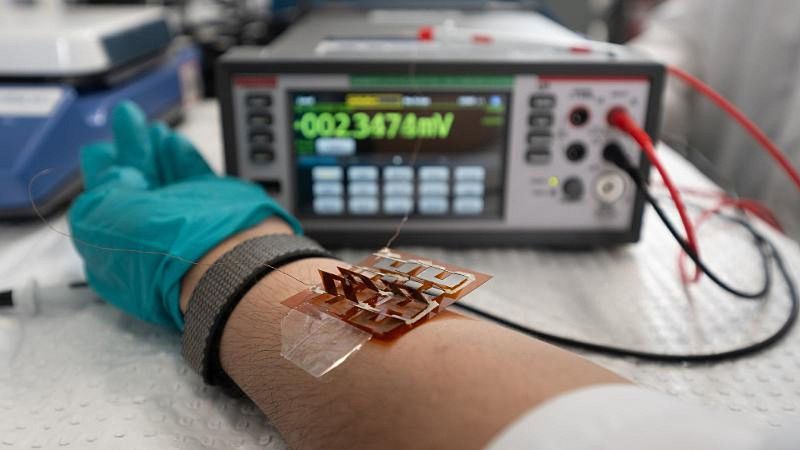
Advances have been achieved in the development of devices driven by body heat, putting them within reach of practical implementation.
It may not have occurred to you to tap the potential of your own body heat as a renewable energy source. Yet, given the rapidly increasing demand for batteries to power our increasingly electrified world, and the accompanying strain on Earth's resources, experts have been exploring this unconventional option for a while now.
Research into wearable electronics has revealed a promising area, but commercialization is proving to be a challenge.
Scientists at Queensland University of Technology have successfully addressed the challenge of creating wearable devices that are both flexible and user-friendly by developing a highly thin and flexible film that enhances their wearability and functionality.
How do wearable devices that convert body heat into electricity function?
Professor Wenyi Chen describes the significant development.
“Unfortunately, setbacks such as inflexibility in production, intricate manufacturing processes, substantial costs, and inadequate performance have hindered the widespread adoption of these devices.”
For low-consumption applications such as heart rate, temperature, and movement sensors.
The research team based at QUT moved forward with a novel approach by implementing extremely minute crystalline structures called 'nanobinders', which specify the formation of a uniform layer built from bismuth telluride sheets.
"We have developed a highly performant, flexible, scalable, and low-cost thermoelectric film that can be printed on an A4-sized sheet, setting a new standard for flexible thermoelectric materials," says Professor Chen.
The nanocrystals were synthesized using a process known as solvothermal synthesis: a method that combines high pressure and temperature to produce the desired crystals within a solvent.
The movie was then screen-printed, which makes it feasible for high-quality mass production, before being heated to a temperature close to its melting point to make the particles fuse together.
The scope of innovative solutions for managing human-generated heat has expanded beyond thermostat-controlled environments to personal electronics, specifically smartphones. With the rising dependency on mobile devices, understanding how to regulate their temperature has become increasingly important.
Chen and the Queensland University of Technology team envision a multitude of potential applications for this innovation.
In addition to paving the way for wearable devices such as smartwatches, this technology could also be used to cool electronic microchips, enabling them to be integrated into compact spaces like smartphones and computers, thus enhancing their efficiency.
system,” adds Chen.

Post a Comment for "Body heat could be the next big renewable after scientists invent ultra-thin tech to power wearables"
Post a Comment